
TCFD | Climate Change Impact Modelling Tool
Transform Climate Risk into Actionable Intelligence
Climate change presents significant physical and transition risks to businesses, infrastructure, assets, and investment portfolios. Understanding these risks requires more than static reports—it demands dynamic, evidence-based modelling that integrates climate science with operational and financial decision-making.
The Sentient Hubs TCFD Climate Change Impact Modelling Tool enables organisations to assess, model, and visualise the potential impacts of climate change across assets, operations, and supply chains, using an integrated digital environment that combines climate science, geospatial intelligence, digital twins, engineering simulations, and enterprise data.
Designed to support climate resilience planning and TCFD-aligned climate risk assessments, the platform transforms complex climate data into clear, actionable insights.
Interactive Climate Impact Visualisation
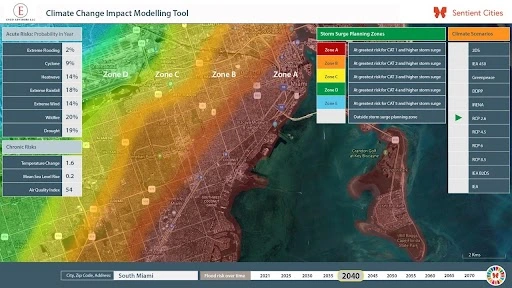
Using an intuitive GIS-based interface, users can visualise climate impacts across cities, infrastructure, facilities, and entire asset portfolios.
The platform enables organisations to:
- View climate hazards spatially across maps and digital twins.
- Compare multiple climate scenarios and emissions using future climate pathways.
- Climate hazard assessment, including heat, flooding, drought, storms, and sea-level rise.
- Assess future impacts across different time horizons (2030, 2040, 2050, 2070 and beyond).
- Identify vulnerable assets and critical infrastructure.
- Visualise flood extents, storm surge, heat stress, sea-level rise, bushfire risk, drought and other climate hazards.
- Analyse how climate risks evolve under different adaptation strategies.
Rather than relying on spreadsheets or isolated reports, stakeholders can explore climate impacts interactively and understand where risks are greatest.
Multi-Scenario Climate Modelling
The platform supports scenario-based analysis by integrating recognised climate projections and hazard datasets.Users can model impacts using multiple climate scenarios, including:
- Low, medium and high emissions pathways
- Future climate projections
- Sea-level rise scenarios
- Storm surge simulations
- Extreme rainfall events
- Heatwave frequency
- Coastal inundation
- Flood depth modelling
Scenario comparisons help organisations understand uncertainty while developing resilient long-term strategies.
Asset Exposure and Risk Assessment
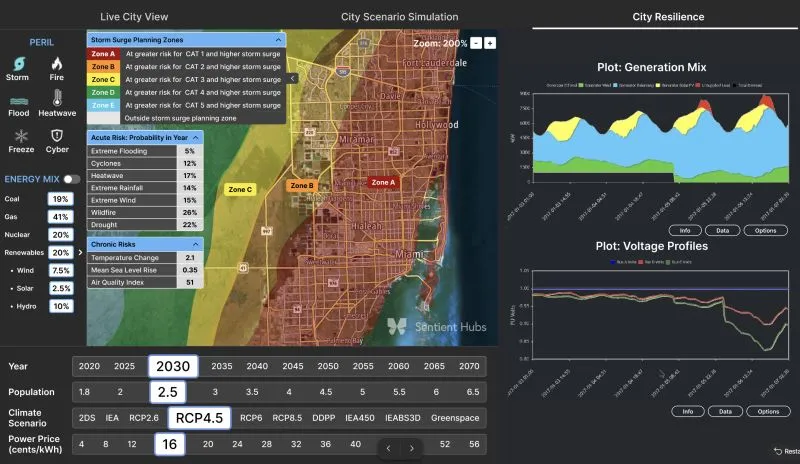
The platform automatically evaluates how climate hazards affect physical assets and infrastructure. Example outputs include:
- Asset exposure scores
- Flood probability mapping
- Climate hazard intensity
- Infrastructure vulnerability
- Consequence analysis
- Critical asset prioritisation
- Risk heat maps
- Asset resilience indicators
Interactive dashboards enable users to quickly identify assets requiring mitigation, adaptation, or further investigation.
Supporting TCFD-Aligned Reporting
The Climate Change Impact Modelling Tool supports organisations in developing evidence-based climate disclosures aligned with the recommendations of the Task Force on Climate-related Financial Disclosures (TCFD).
The platform provides analytical support across the four TCFD pillars:
- Governance – Visualise climate risks across organisational assets and responsibilities.
- Strategy – Evaluate resilience under different climate scenarios.
- Risk Management – Identify, monitor and manage climate-related risks.
- Metrics & Targets – Quantify exposure, vulnerability, adaptation progress, and resilience indicators.
By combining scenario modelling with operational intelligence, organisations can strengthen both climate reporting and strategic planning.
Applications Across Industries
The TCFD Climate Change Impact Modelling Tool supports organisations across a wide range of sectors, including:
- Environmental Management
- Built Environment
- Energy and Utilities
- Infrastructure
- Water Management
- Local Government
- Transport
- Manufacturing
- Property and Real Estate
- Financial Services
- Mining and Resources
